
Walk an Erie County Street by Address
A useful street directory search begins with one exact situs address, meaning the physical location of the land. Erie County Real Property Tax Services can connect that address to a parcel, its SBL or tax identifier, and a current owner or mailing contact. That is a starting point, not proof that the owner lives at the site. The parcel reference then gives the Erie County Clerk’s party-and-instrument index a stable way to reach the deed trail. Buffalo permit and code data can add a dated activity clue, and a reverse directory can identify an historical listing at an address.
- Search the address in the county parcel or tax system and save the situs spelling, municipality, SBL, PIN, owner spelling, mailing address, roll year, and deed date.
- Open the same parcel in Erie County On-Map, check the parcel boundary and adjacent lots, and note any ZIP, school, district, or street layer that helps distinguish the location.
- Use the owner, parcel ID, legal description, book/page, or map number in the Clerk’s BrowserView. The Clerk does not offer an ordinary address field for land records.
- Follow the acquisition deed to the seller, then test that seller against an earlier deed. Record the legal description as well as the street number because addresses can change.
- For a past household clue, check a dated Buffalo reverse or criss-cross directory and then its alphabetical entry. A voter record is not a public street browse; any fuller voter-file request has a defined elections purpose.
Each result should be labeled by what it actually supports: title, tax mailing contact, construction activity, or a historical directory listing. That restraint makes a street-by-street record trail useful when a house has multiple units, a corporate owner, or an address that has changed form.
Erie County Street Directory Starts With Situs
Erie County separates the situs address from the mailing address on a parcel card. The situs locates the property. The mailing address identifies where the tax material is sent and may be in another town, another state, or attached to an estate or organization. A homestead exemption can be an owner-occupancy clue, but it does not name other people in the home. For a condominium, complex, or multiple-building parcel, use the narrative, subparcel, and parcel components rather than stopping at the street number.
PIN and SBL are the county’s durable parcel labels. A PIN begins with the six-digit county SWIS code and then carries section, block, and lot components. An SBL carries the section, block, and lot without that county prefix. The parcel card, map popup, and tax record may show each in a slightly different display. Preserve both exactly as returned before moving from a street address to a deed search.
- Parcel
- A mapped piece of taxable land, which may hold one building, several buildings, or a unit interest.
- Situs address
- The physical property address used to locate land, distinct from the owner’s mailing address.
- Plat
- A recorded map that can connect a street address to a subdivision, lot, or block.
- Criss-cross directory
- An address or reverse section that lists historical entries by street rather than by surname.
Note: A parcel snapshot needs its roll year because ownership, assessment data, and mailing fields can change after the search date.
Erie County Parcel Fields for Street Searches
The county’s property tools are the proper front end for an address search. Official county material documents address, owner-name, and SBL or tax-identifier searching in the parcel system. On-Map can query by address, owner, or SBL, then offers a clickable parcel view and a Find Data toolbar for a permitted query or export. Use the parcel record to establish the physical site before treating an owner name as a Clerk index term.
| Erie County field | Control or value | How it helps a street check |
|---|---|---|
| Address | Optional parcel search field | Locates the situs parcel when the current address format is known. |
| Owner name | Optional parcel search field | Finds a parcel by current tax-record owner; normalize last/first names and organization names. |
| SBL or tax identifier | Optional parcel search field | Provides the most precise route when a street has similar numbers or a unit has a subparcel. |
| On-Map SBL, owner, address | Optional map query | Places the parcel among neighboring polygons and opens the tax route where available. |
| Find Data toolbar | Optional layer query and export | Supports selected parcel-field work without converting the map into a household list. |
The parcel layer’s sample fields include address number and name, narrative legal lines, frontage, depth, assessed or calculated acres, class, property description, owner fields, mailing street/city/ZIP, school area, deed date, and roll. These fields are most useful when copied together. A bare owner name or a map pin is much easier to misread.
The Erie County property-search guidance shows the county’s parcel search entry point.
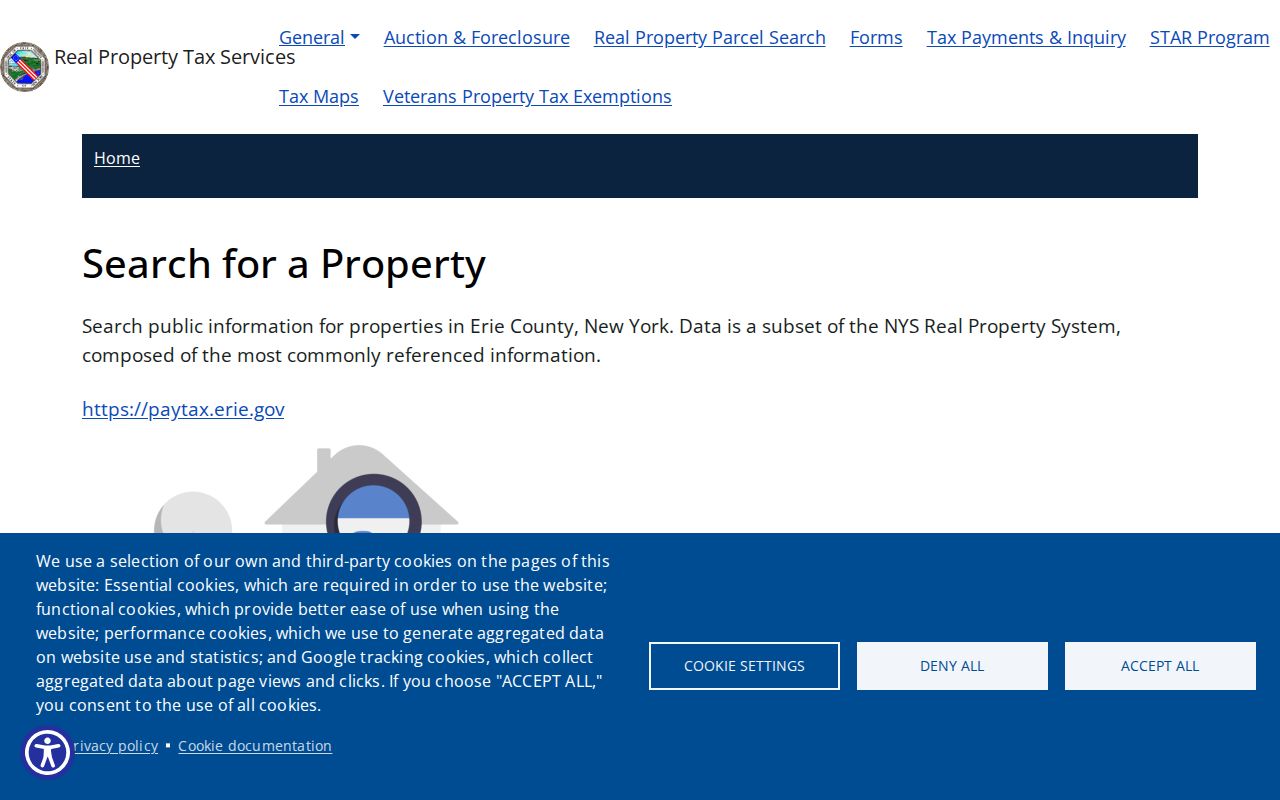
The search screen supports the first part of the address chain, where an address becomes a parcel identifier rather than a claim about every resident.
Browse Erie County Streets on On-Map
Erie County GIS On-Map is useful for seeing the block around a known parcel. Zoom to a street segment, click a parcel polygon, and compare the popup with the tax record. Parcel, ZIP, school, legislature, wetlands, floodplain, agricultural district, soil, and street layers add geographic context. They do not change a generalized map into a legal survey, and the county says that legal descriptions still need confirmation from the Clerk or a surveyor.
The Erie County GIS Internet Mapping viewer exposes the layer panel, map browse, and parcel-query workflow.
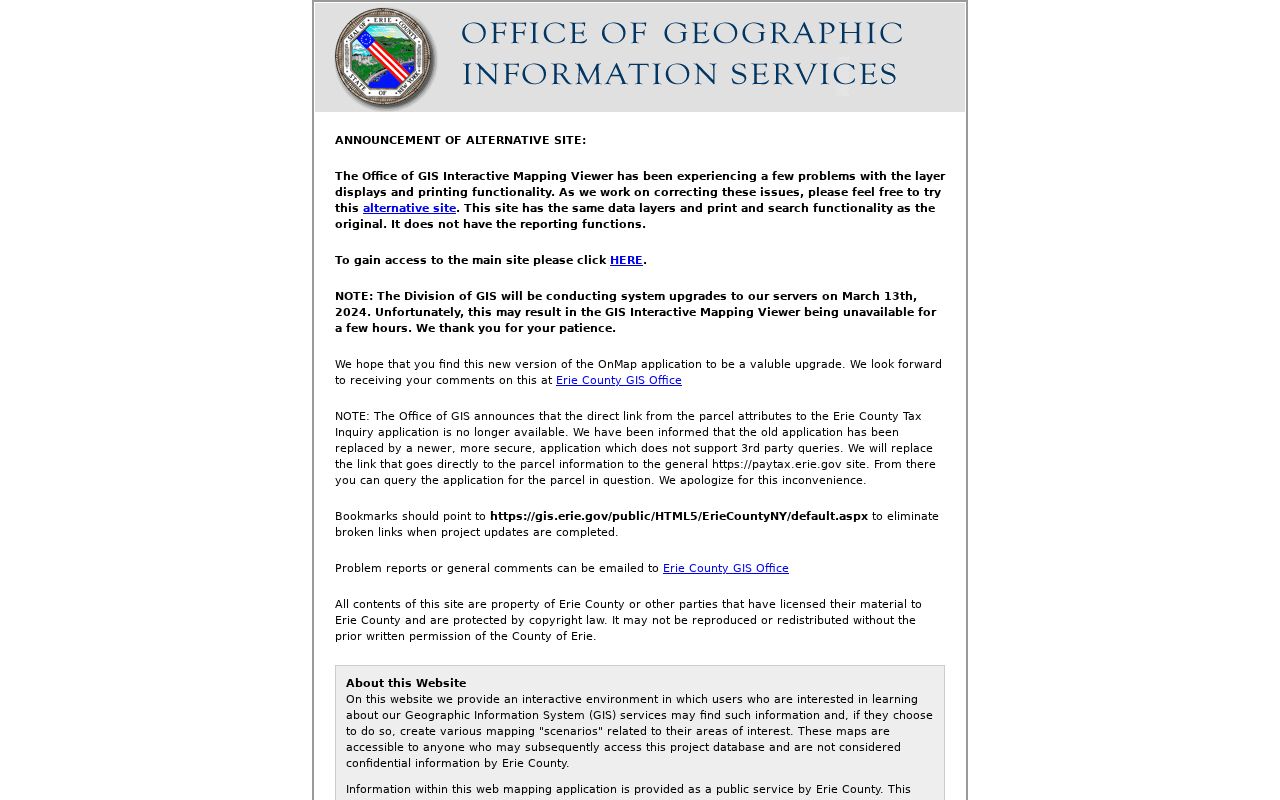
Use the GIS result to order parcels along a street, then verify title or a legal description through the appropriate Clerk record.
The county’s official parcel-layer service documents the address, owner, mailing, class, dimensions, deed-date, PIN, and SBL fields carried in the mapped data.
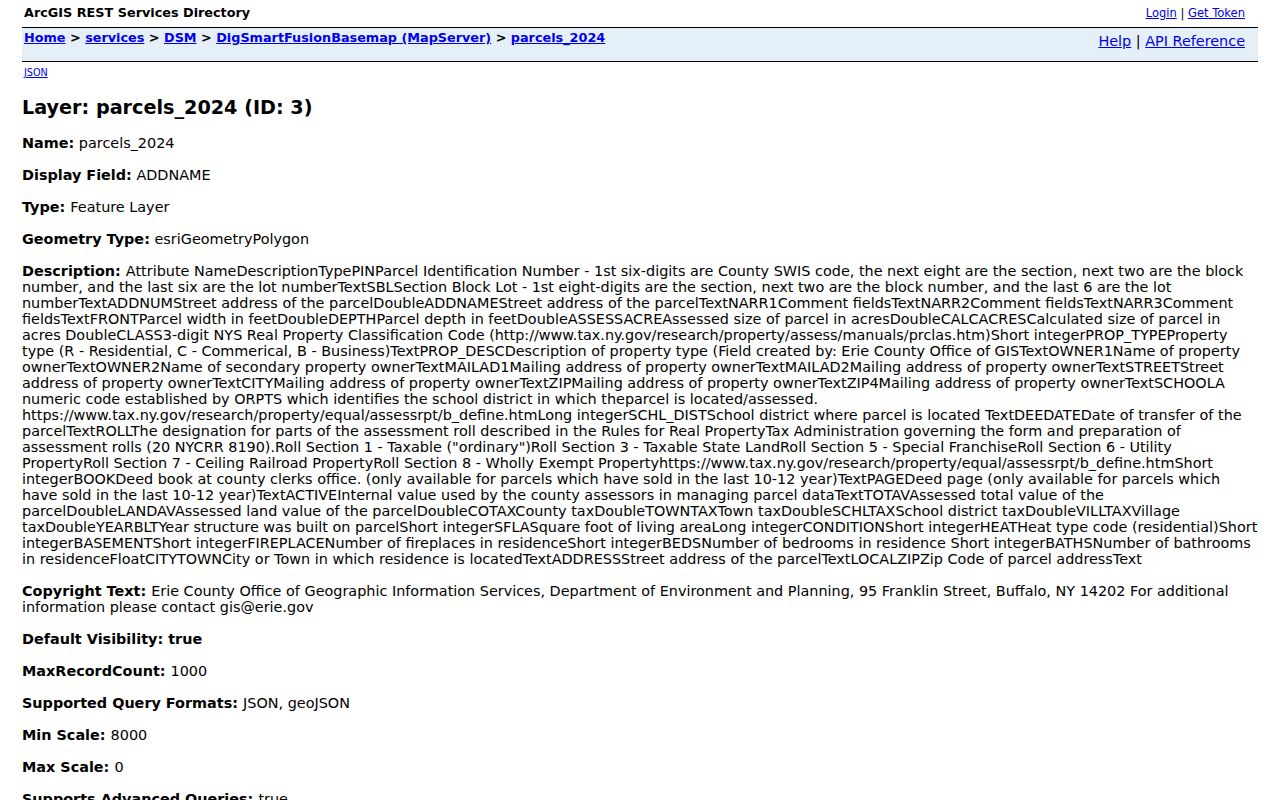
The field schema explains why a street result may show a tax owner or mailing address without showing every occupant, boarder, or person at the site.
Erie County Address Records by Street
No single Erie County street directory is a full household roll. The address-keyed sources below provide different kinds of evidence and use different access channels. Start online where the source permits it, then use the Clerk’s office or request form, Buffalo’s records services, and library collections when coverage or digitization ends.
| Address record | Local keeper | Street-level evidence | Access path |
|---|---|---|---|
| Parcel and tax card | Erie County Real Property Tax Services | Situs, owner, mailing address, SBL/PIN, class, values, exemptions, school district | paytax and GIS; save the current roll date |
| GIS parcel layer | Erie County GIS | Parcel geometry, owner/address fields, SBL/PIN, and contextual layers | Public viewer or GIS service; generalized map |
| Deed, mortgage, lien, or judgment | Erie County Clerk | Parties, instrument, date, book/page, consideration, and legal description | Modern index online; older books, terminal, written request, or office research |
| Buffalo permit or code case | Buffalo public data and DPIS | Address/SBL, work or case date, responsible party, code, and status | Public data or ePermits; not all files digitized |
| Reverse directory | B&ECPL Grosvenor Room and historical collections | Historical address listing, household clues, and owner or resident marks | Digitized, library database, hard copy, or microfilm depending on year |
| Voter file | Erie County Board of Elections | Registered-voter data only under a defined request | FOIL request with elections purpose; no casual public street browse |
The County Clerk keeps deeds from 1808, but its online deed index begins January 1, 1986 and online deed images begin January 1, 1960. For older work, book/page information, the Graves Index, in-person research, or a focused Clerk request may be required. The Clerk’s BrowserView land-record index is the modern party, document, parcel, and legal-description route.
Follow Erie County Deeds Along a Street
When an address is already tied to an SBL, the next street-directory step is a title trail. Find the current owner’s acquisition deed, record the grantor and legal description, and search the seller as the earlier grantee in the preceding period. A grantor is the person or entity transferring an interest; a grantee receives it. This chain works only when the legal description, lot language, frontage, depth, or adjacent-owner detail still matches the same parcel.
The Clerk’s land-record search has party name, document type, instrument number, book/page, map number, parcel ID, date, legal-description, and parcel-component fields. It has no address field. Its results can show instrument number, date, book/page, consideration, map number, parcel ID, parties, legal lines, and linked documents. Online images require a registered account; metadata remains a practical search lead, and BrowserView is available for non-Windows users.
For a pre-1960 deed image, use the Liber or Book/Page route. For a pre-1986 index gap, ask the Clerk for the older books or make a focused document request with the current and former street name, municipality, approximate year, SBL/PIN, and any book/page found. The request form says the office will contact the requester within two business days, accepts one attachment up to 1 MB, and cannot email certified copies. These access routes are more reliable than asking for every instrument tied to a surname.
Note: A deed transfers title, while a mortgage, satisfaction, lien, or lis pendens supplies context but does not prove that someone lived at the address.
Buffalo Street Records for Permits and Cases
For a Buffalo address, permits and code cases add an event layer to a street directory search. The City says its public-data permit material begins January 2, 2007, and the code-violation dataset begins March 28, 2016. A permit may identify an applicant, owner, contractor, work type, and date. A code result may show the address, SBL, case number, code, and active or closed status. Neither is a complete archive or a roster of current occupants.
The Erie County Tax Inquiry and Parcel Search is the tax-side starting point before checking a deed or a Buffalo address event.
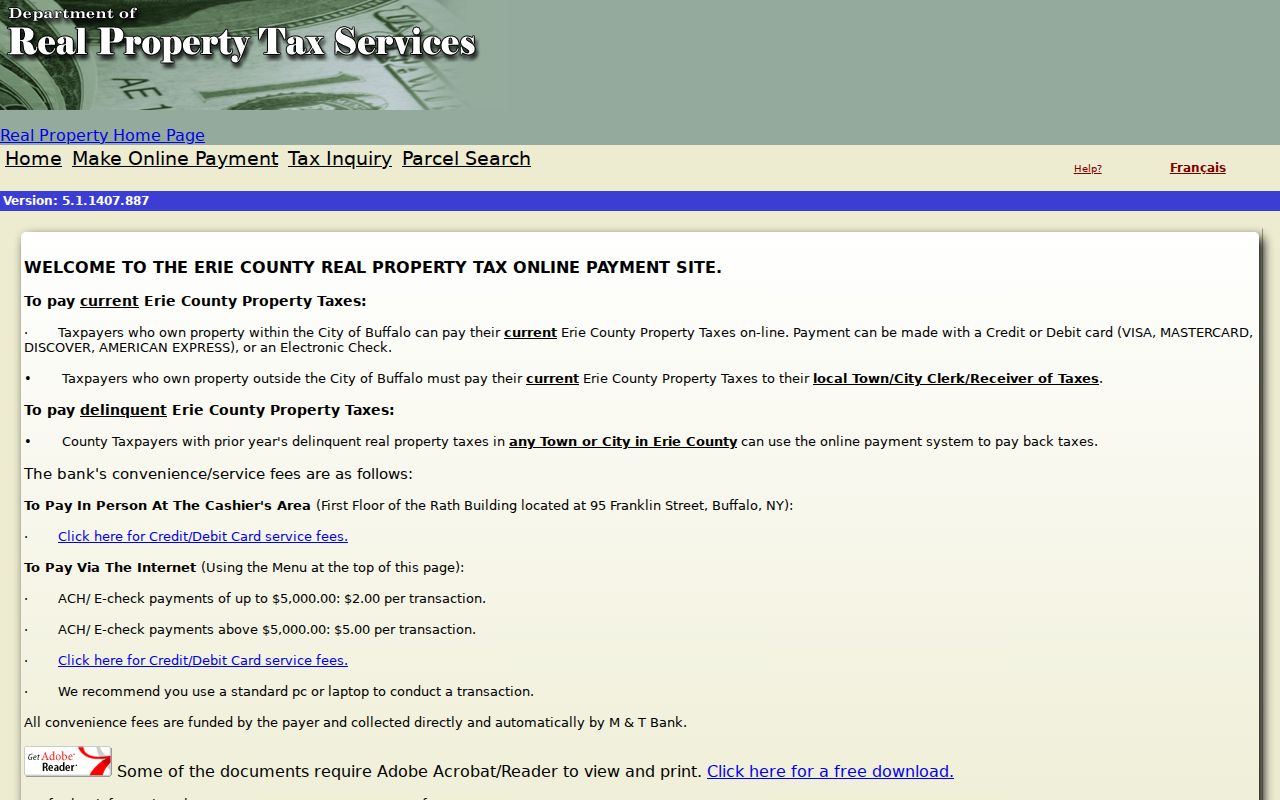
The tax portal helps retain the current parcel identifier, which is more stable than a street number when the Clerk index or a historic document uses legal-description language.
Use an exact address, correct ZIP, date range, and spelled-out numbered street in Buffalo ePermits. The City’s permit guidance lists Monday, Wednesday, and Friday walk-ins and Tuesday and Thursday appointments following the October 2025 processing change. Older construction research moves to assessor maps, tax books, Sanborn maps, and Buffalo Records Management rather than an assumed online permit file.
Former Buffalo Names in Street Directory Work
A modern street search can fail when a historic source uses an earlier Buffalo name. The official former-name guide pairs names such as Ferry and Amherst, Guide Board and Porter, Seneca Mills and Seneca, and Ohio and South Park. The guide does not supply an effective year for each change. For date-specific work, compare the old and current names against city maps, the 1896 engineering index, and the deed’s legal description.
That issue matters on streets near older municipal boundaries. Black Rock was annexed to Buffalo in 1854, and a historical listing may be filed under a village or ward context that does not match a current planning label. Record the municipality, ward or block notation, former street spelling, and source year next to the present address. It is safer to report a search under both names than to force a match based on a street number alone.
Erie County Voter Data Limits
New York’s voter lookup is a self-service confirmation tool. It asks for county, last name, first name, date of birth, and ZIP, and it does not offer a public street-by-street roster. A non-match can reflect an altered name, ZIP, move, list-maintenance status, or a protected record. It should never be presented as proof that a person did not live on a street.
Erie County has a separate full-file request form with geographic choices such as town, ward, and district, possible formats, field selections, party options, and a noncommercial-use acknowledgement. Election Law §3-103(5) requires an elections purpose for voter-registration lists. Voting history, where lawfully supplied, means participation and never reveals a ballot choice. The county’s self-lookup remains the safer public layer; address-level voter material is not for republication.
Buffalo Reverse Directories by Street
For a historic street-directory question, the Buffalo & Erie County Public Library’s Grosvenor Room is the key access point. Its Buffalo directory run is described as 1828 to the present, with published gaps, while reverse or address sections are generally available from 1929 onward. The library’s digitized Buffalo directories cover 1832 to 1913 through New York Heritage, and the History Museum holds Buffalo directories from 1828 to 2001 plus suburban directories from 1949 to 2001.
Search the address section for the target year, then use the alphabetical entry to read the name, spouse notation, identifying abbreviations, house number, owner or resident mark, widow mark, and later telephone. A directory identifies a publisher’s listing, not every member of a household. For the historical collection itself, use the Erie County city directory collection route rather than treating one reverse-page entry as a modern resident result.
Outside Buffalo, the 1917 Farm Journal illustrated Rural Directory of Erie County can preserve farms and households that urban directory runs miss. Pair a historical listing with local census microfilm, tax books, Sanborn maps, an obituary, or a deed as the period requires.
Limits of an Erie County Street Directory
An Erie County street directory can show public parcel ownership, mailing contacts, recorded instruments, dated construction activity, and selected historical listings. It cannot create a complete roster of occupants, boarders, children, utility customers, delivery recipients, or every person in a building. DMV personal information is restricted by the federal Driver’s Privacy Protection Act. An owner’s out-of-area tax mailing address may indicate where tax mail goes, but it is not proof of residence.
New York’s Address Confidentiality Program may substitute a secure Albany address for eligible participants, and protected voter registration is separately confidential. Those protections can explain why a public record does not display an expected address. Do not identify someone as protected, try to reconstruct a withheld location, or combine public records to pressure a person. For a question about verifying one person rather than tracing an address, use the narrower Erie County resident lookup path and confirm the underlying custodian record.
Lawful use. Erie County street and address records are for personal, lawful research and civic curiosity. New York stalking and harassment laws can apply when public details are combined to intimidate, watch, or harm someone.