
Erie County Resident Lookup Records
A good Erie County name search separates the question from the source. The Erie County parcel and tax systems can show the owner of a parcel, its situs address, and a mailing address, but they do not list every occupant. The Erie County Clerk's deed index identifies transfers of title and legal descriptions. Court systems identify public case parties, while vital indexes and historical directories supply date-bound evidence. Each source has a different meaning, so use the result language precisely: a person may have owned, filed, appeared, or been listed at an address without living there now.
| Record | What It Confirms | Where | Access |
|---|---|---|---|
| Parcel and tax roll | Parcel owner, situs, mailing address, assessment details | Erie County parcel and tax search | Public county subset; not a household roster |
| Recorded deed index | Transfer parties, dates, instrument and legal description | Erie County Clerk land records | Deeds maintained from 1808; online index begins in 1986 |
| Voter record | A cooperative registration check for a known voter | New York voter lookup | Self-lookup; full files require an election purpose |
| Court index | Public case party, caption, status, and docket history | NYSCEF and eCourts | Eligible public cases only |
| Vital and historical sources | Event or dated household evidence | New York vital-record genealogy access | Eligibility and time limits apply |
Start with the Erie County parcel system only when ownership is the question. Start with a court or probate index when the question involves a case or heir. For a dated household connection, use the library material and a vital or probate source to test the match. This Erie County method prevents a single name hit from becoming an unsupported claim about a living person.
Erie County Resident Lookup Name Checks
Buffalo's directory, court, and property records contain many repeated surnames. Normalize middle initials, suffixes, married and maiden names, and common spelling variants before searching. Then anchor each result to a municipality and a time period. A parcel owner with the same mailing ZIP is only a candidate. A court party may have moved long ago, and a business service address may not be a home. The safest result is a convergence of independent records that answer different questions.
For example, an Erie County parcel record can establish a current owner name and SBL, the deed index can connect that SBL or legal description to a transfer, and an old directory can show a household listing for a particular year. Record the source date beside every result. When the only shared fact is a common name, mark the issue unresolved. Do not bridge the gap by collecting more sensitive information.
Erie County Court Record Checks
For public civil or e-filed matters, NYSCEF case search help describes searches by case identifier, first and last name, business name, county, case type, date, and block or lot for tax-certification matters. Erie e-filing became mandatory for covered filings in 2013, and online coverage still depends on case type and commencement date. The Erie County Court page and other eCourts systems remain necessary because no one portal holds every Erie County court category.
An Erie County court name result should be read as a party appearance, not as a character statement or residence finding. Compare the case caption, county, party role, dates, and public document titles. Sealed matters, many family matters, youthful-offender cases, adoption records, and other protected files are not general public results. If a file is not online, ask the appropriate clerk whether a public docket or copy is available rather than inferring why it is absent.
The official NYSCEF help page shows the name, identifier, and county choices used for eligible searches.
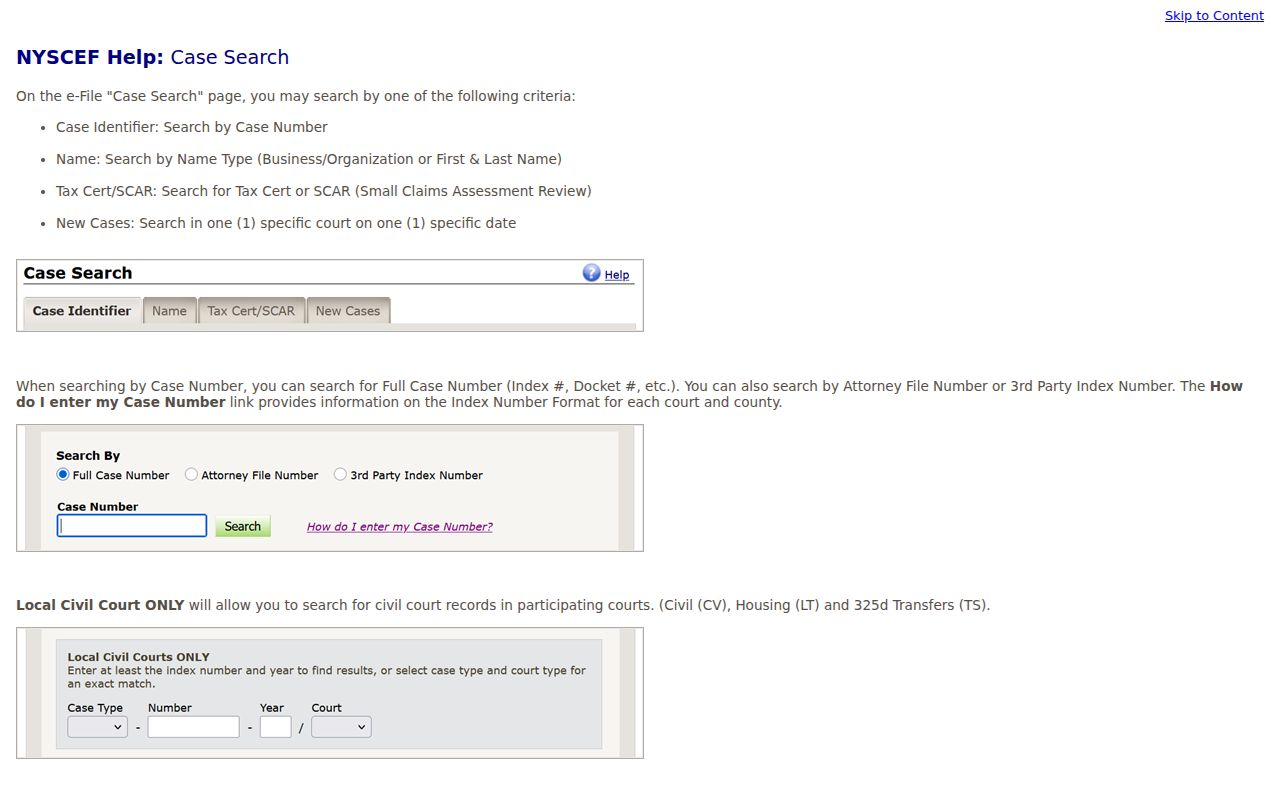
Use the Erie County filters to narrow a name result before treating any docket as a relevant Erie County court record.
A typical public docket result can include the following fields:
- court and county, plus the index or case number;
- caption, parties, party roles, and case type;
- commencement date, current status, judge or part, and appearances;
- docket entries, document titles, and any listed disposition; and
- instructions for a copy or a certified court record.
Note: Erie County court records are divided by court and case type, so a missing NYSCEF result may require a clerk inquiry elsewhere.
Confirming an Erie County Resident
Verification is a short, disciplined sequence. First use a source that relates the person to a known place or date. Next, check a second source with a different purpose. Erie County property information can supply a parcel owner and SBL, while the Clerk's records can test whether that name appears as a deed party. A court caption, directory entry, or obituary may then confirm a date or relationship. A voting result should be used only as the limited self-service confirmation New York provides.
- Write down the full name, likely municipality, and the date range you are testing. Keep possible name variants separate.
- Search the Erie County parcel system by address, owner, or SBL when ownership is relevant. Note whether the listed address is situs or mailing.
- Use the party name, parcel identifier, legal description, or book and page in the Clerk index to locate a matching instrument.
- Check an eligible court index, historical directory, obituary, or vital index for an independent date, role, or family connection.
- Stop when two records do not align. Request a specific public record from the custodian only after the record category and date range are clear.
- Docket
- A court's running list of filings, events, appearances, and orders in one case.
- Index and image
- An index is the searchable description of a record. An image is the scanned document itself, which may need registration, a fee, or an office request.
- Certified copy
- A copy authenticated by the custodian for an official purpose. It is different from an informational index result or a plain copy.
When the question shifts from one person to several parcels on a road, the address method belongs on the Erie County street directory. That keeps a one-person name search from turning into an unreliable street roster.
Erie County Vital Record Routes
Vital records have their own custodians and access rules. The New York State Department of Health provides statewide records it holds, while Buffalo events have an important Erie County local split: Buffalo births, deaths, and marriages before January 1, 1914 remain with the Buffalo City Clerk rather than the state holdings. The Erie County Clerk genealogy room also holds Buffalo birth microfilm for 1881 through 1913, Buffalo marriage material, naturalizations, and census microfilm, but it does not hold Buffalo death records.
For genealogy copies, New York generally requires a birth record to be at least 75 years old with death known, a death record at least 50 years old, and a marriage record at least 50 years old with both spouses known deceased. A direct descendant may have an exception with proof. Certified birth copies remain restricted under Public Health Law §4173, and death-record use has restrictions under §4147. These rules mean a name search should identify the event place and access lane before a request is sent. For events outside Buffalo, the local registrar is another certificate custodian; state mail, phone, online, and vendor ordering are separate routes to the state records it holds.
New York's birth-record page describes the state certificate route and eligibility information.
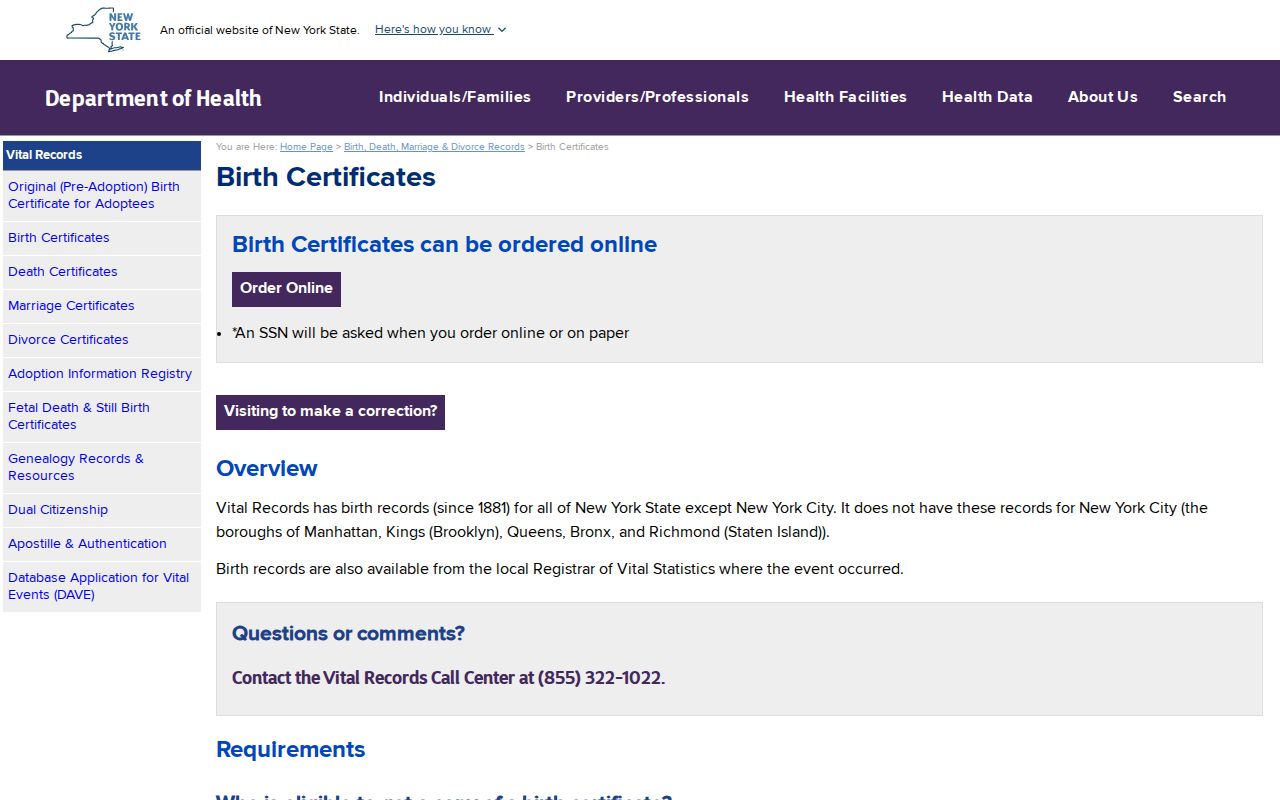
The state route is not a general name search, and an old genealogy copy is not the same as a certified record.
For a former classmate or historical household, yearbooks, directories, local newspapers, and obituaries can create a dated lead. The Erie County city directory collections provide the fuller historical shelf, while an obituary, probate file, or certificate request can help resolve a same-name conflict.
Erie County Heir Record Clues
Some resident questions need a specialized record rather than a broad name search. For an heir, begin with Surrogate's Court probate material. Petitions, waivers, affidavits, and estate filings may identify a decedent, fiduciary, or beneficiary, though file status and confidentiality still control access. Wills filed only for safekeeping are not public. An obituary can help date a death, but it remains a historical clue until it is compared with the court file or another custodian record.
For a regulated credential or business affiliation, use the New York Department of State Licensee Search or the state business database. License results can show status, type, and expiration. Entity results can show organization date, jurisdiction, county, service address, and filing history. Neither makes a service-of-process address or license contact into proof of a person's home. New York does not generally maintain every LLC member or corporate officer in the public entity database.
When the official trail ends, narrow the request rather than making it broader. The Erie County Clerk's online document request permits a requester to identify a document type, approximate filing date, party name, address context, and book, page, or file number. Supplying a book and page avoids a search fee; the Clerk says it will make contact within two business days. For agency records outside a specific confidential category, New York FOIL, Public Officers Law Article 6, §§84-90, is the fallback path for existing records, not a way around a sealed or protected file.
Note: Describe the requested Erie County record by name, date range, and custodian instead of requesting a broad file on an individual.
Erie County Historical Resident Clues
For a historical person, Erie County's local collections can solve a name problem that a current portal cannot. The Buffalo History Museum holds the first Buffalo village directory from 1828, including separate pages for Black residents in 1828, 1832, and 1841. Those pages are a collection-specific check when a surname is absent from the main alphabetical section. The Museum also holds address books with reverse material, cemetery and church records, an Erie County Clerk records inventory, and local newspapers.
The Buffalo History Museum library collections and the B&ECPL Grosvenor Room offer public historical leads, not current person directories. The library's yearbooks, digital directories, obituary service, and local newspapers can place a classmate or relative in a year and neighborhood. Test that dated lead with a deed, probate petition, certificate, or another appropriate custodian record before relying on it.
Erie County Resident Privacy Boundaries
Not finding a name can be the correct outcome. New York's Address Confidentiality Program, under Executive Law §108, gives qualifying participants a substitute Albany mailing address and does not erase preexisting public records. Election Law §5-508 separately protects qualifying voter registrations. Sealed court files, adoption material, restricted vital certificates, and DMV information are also outside a general public search. A missing result is not proof that a person never lived in Erie County.
The voter lookup is intentionally narrow. A registered voter checks a record using county, first and last name, date of birth, and ZIP, and a non-match can reflect a moved address, a name variation, list maintenance, or a protected record. The county's full voter-file request form permits fields and geographic formats only with a stated election purpose under Election Law §3-103(5). Voting history means participation, never ballot choices.
New York's sex-offender registry is another limited public record. It permits a search by one of last name, county, or ZIP and covers public Level 2 and Level 3 information. It is not a general-purpose resident finder.
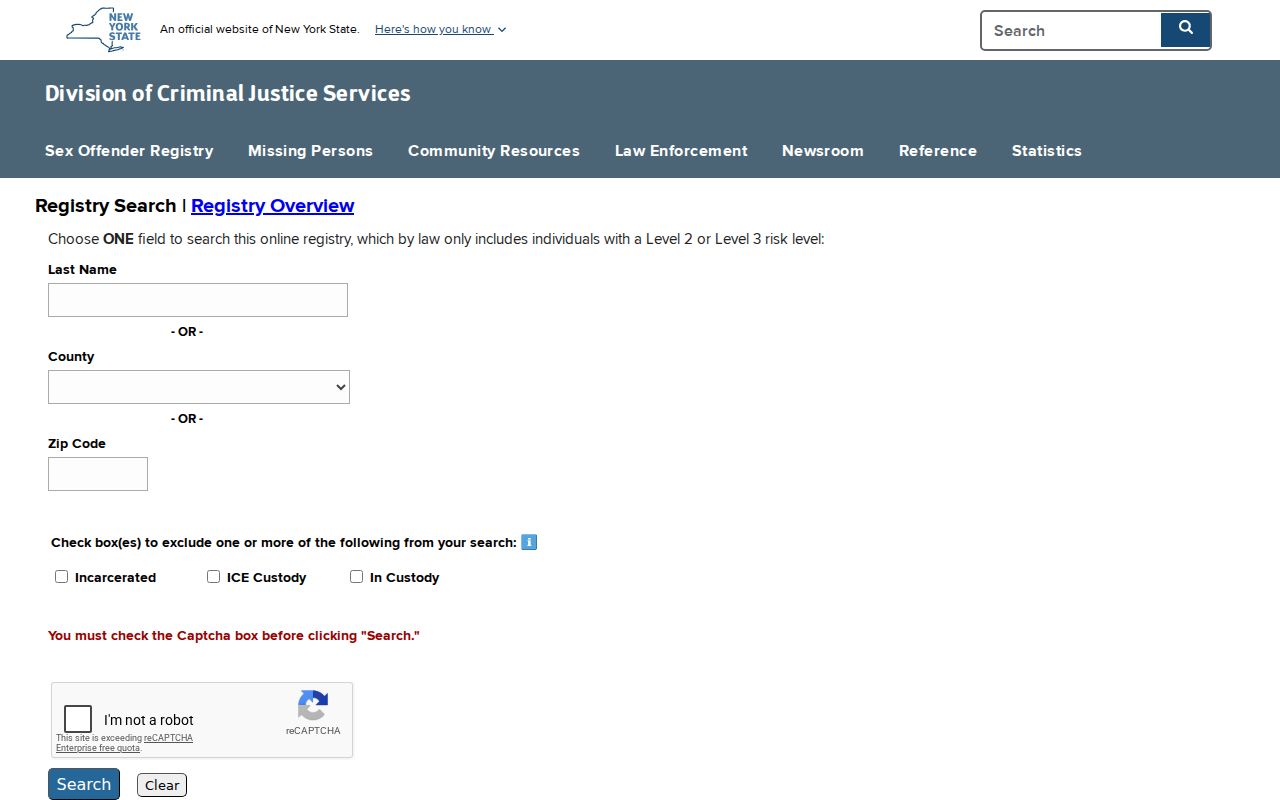
Choose the record system that matches the question, and respect its coverage and legal-use limits.
Limits for Erie County Resident Records
Official sources are strongest when their limits stay visible. A property roll identifies ownership, not every resident. A deed identifies a transfer, not necessarily occupancy. A directory reflects a publisher's dated listing, not a current address. A court caption identifies a party in a particular matter. Keeping those distinctions makes an Erie County name search more useful for family history, reconnecting with a known person through consent, estate research, or checking a document trail.
If a record appears wrong, contact the office that maintains it and preserve the record date, identifier, and source URL. Do not repeat an unverified address or use a copied result as a final answer. The better conclusion is often modest: a person was historically listed at an address, owned a parcel on a date, or appeared as a party in a public filing. That precision protects both the researcher and the person named in the record.
Note: Store only the identifiers needed to reproduce a result, and omit private contact details from any personal research notes shared with others.