
Erie County City Directory Shelves
Buffalo is the center of Erie County's historical directory shelf. The Buffalo & Erie County Public Library's Grosvenor Room describes a complete Buffalo run from 1828 to the present, although publication did not occur in every year. Its guide identifies surviving runs for 1828; 1832 through 1844; 1846 through 1942; 1946; 1948; 1950 through 1953; 1955 through 1978; 1980; 1982; 1984; 1987; 1989; 1993; 1996 and later. Many editions are Polk volumes, while the early publishers vary. Missing years usually mean that no edition was published, not that a library copy is missing.
| Collection | Years | Where Held | Access |
|---|---|---|---|
| Buffalo directory volumes | 1828-present, with publication gaps | B&ECPL Grosvenor Room | Non-circulating name and address research |
| Digitized Buffalo directories | 1832-1913, 77 original volumes | New York Heritage collection | Online image collection |
| Reverse and criss-cross directories | Generally 1929-present in later runs | Grosvenor Room, Ancestry Library Edition, selected hard copy | Address-to-occupant research; confirm edition |
| Buffalo and suburban directories | Buffalo 1828-2001; suburbs 1949-2001 | Buffalo History Museum library | Appointment; museum notes a $15 nonmember research fee |
Two neighboring shelves help fill a break in the annual run. The library has hundreds of yearbooks from the 1880s forward, local newspapers, obituary-request help, vital-index microfiche, church and cemetery material, and federal and state census resources. Buffalo Records Management also lists incomplete Polk directories from 1856 through 1969, together with tax books, land maps, and census microfilm. Use the edition nearest the year in question, then state the gap plainly if no printed volume survives.
Erie County City Directory Access
The Grosvenor Room is more than a shelf of books. Its local and family-history holdings include about 30,000 non-circulating volumes, Buffalo directories, census records, yearbooks, newspapers, and related indexes. Library staff can help identify whether a year is digitized, on microfilm, or in a later printed run. Ask for a collection-level answer first, such as the exact editions for a street or surname, before requesting a page or reel. That approach keeps a research note focused and makes it easier to return to the same source later.
The New York Heritage Buffalo volumes collection is the online starting point for the 1832-1913 run. Its collection view is shown below.
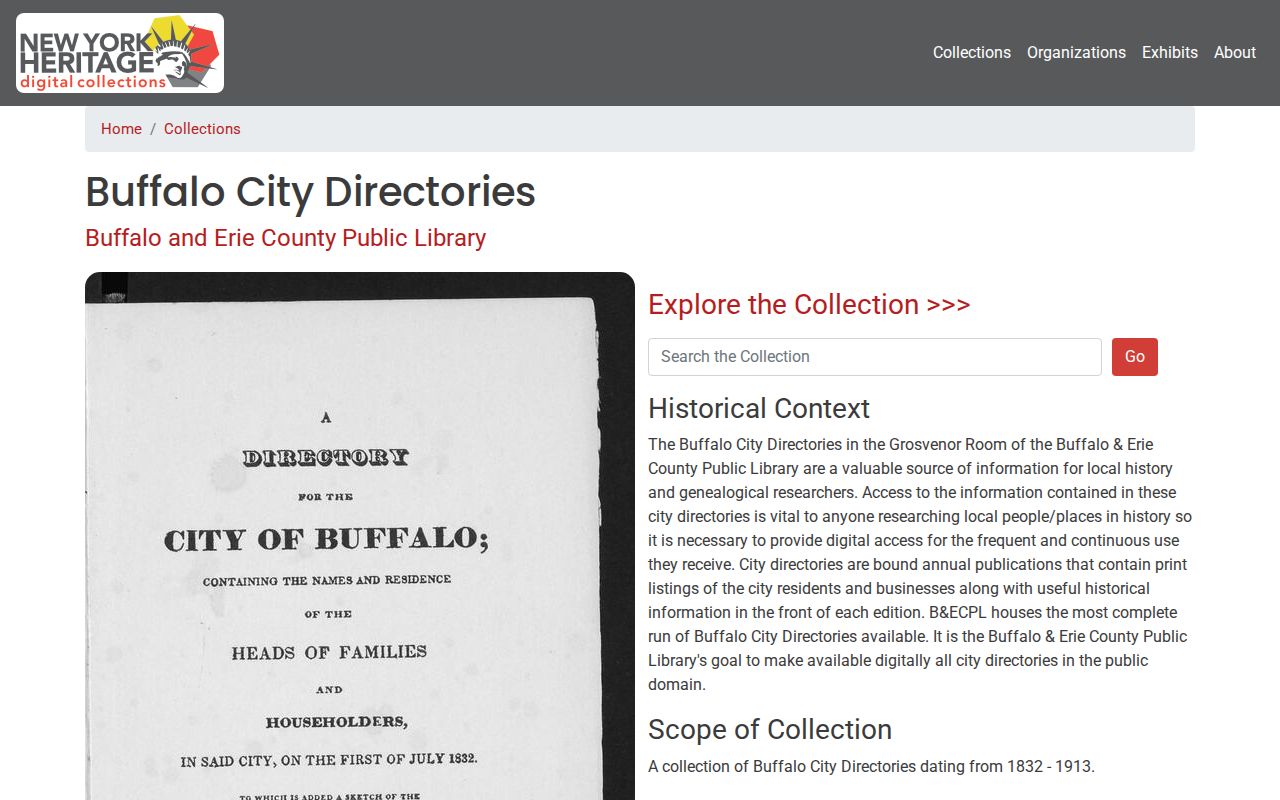
Those digitized volumes support keyword and page-by-page checking, but the page image and the abbreviation list still matter. The B&ECPL Digital Collections also support keyword or Boolean searches by item, file, or collection, including Buffalo directories, Buffalo births, Buffalo Criterion newspapers, and the 1917 Farm Journal illustrated Rural Directory of Erie County.
The Buffalo History Museum library collections provide another route when a year, suburb, or companion source is absent from the library run. The collection screen below reflects the Museum's broader research shelf.
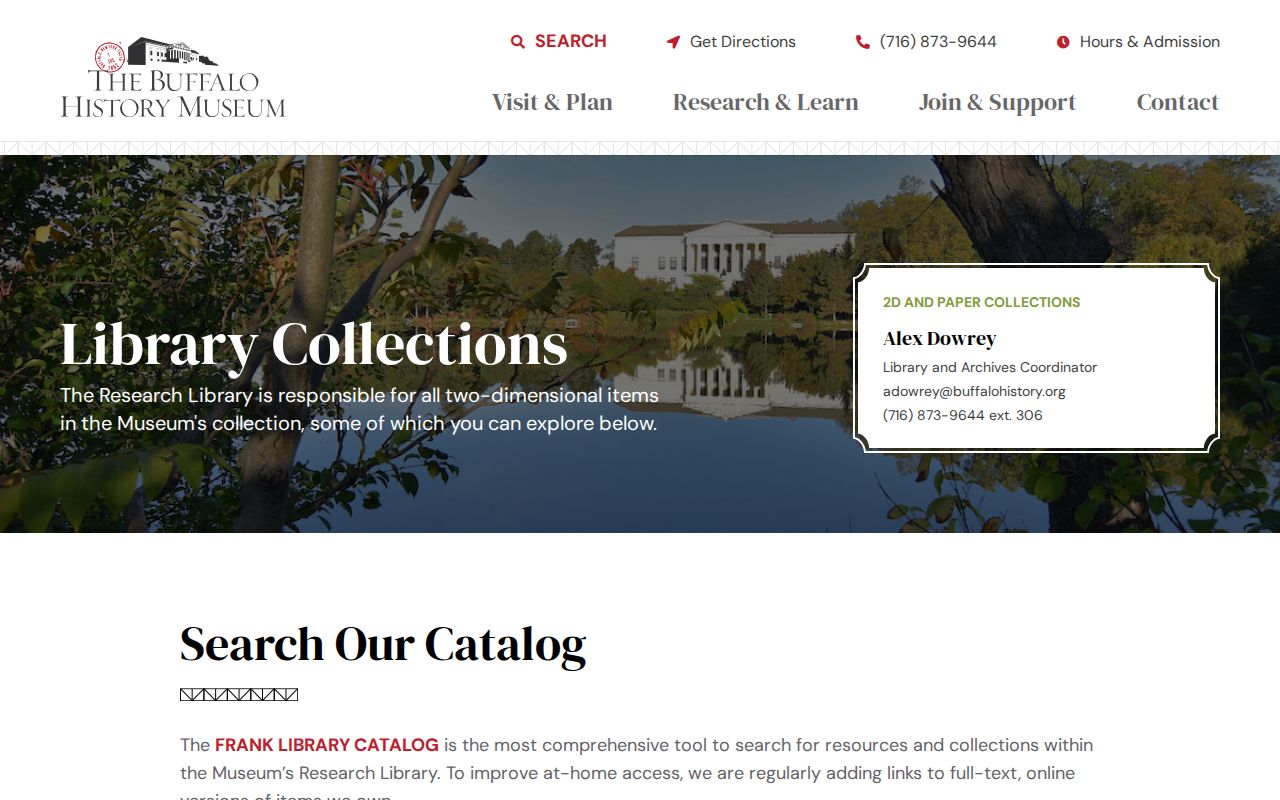
The Museum holds the first 1828 Buffalo village directory, Buffalo Address Books and Family Directories from 1883 through 1915, suburban directories, church and cemetery material, house-history resources, and an Erie County Clerk inventory. Its library research is appointment based, and some restricted material uses the Scholar Pass route.
Erie County City Directory Entry Clues
A Buffalo directory entry needs to be copied as a whole. The alphabetical section commonly gives a surname and given name, a spouse in parentheses, an occupation or employer, and a house number and street. Later editions can add a telephone number or student notation. Owner or resident marks and widow notation may appear, but their exact meaning belongs to the key in that edition. Early volumes tend to overrepresent adult men and can omit children, boarders, many women, and people outside the city limits.
| Name and year | Record the spelling, initials, full edition year, and publisher before comparing another source. |
|---|---|
| Household notation | A spouse in parentheses or a widow notation can separate people who share a name and can suggest a family event to test elsewhere. |
| Address | Copy the number, street, ward or page context, and the address-section page when one is available. |
| Occupation or employer | Use this only as an identifying detail. An employer abbreviation may describe a business address rather than a home. |
| Owner or resident mark | Transcribe the mark exactly and read the edition's key. A mark is not proof of every household member or legal title. |
| Nearby entries | Note adjoining names in a reverse section when they help distinguish an address from a boarding house or institution. |
- Criss-cross section
- The address-order portion of later volumes. It begins with a street and house number, then lists the occupants or listings found there.
- Householder index
- An alphabetical route to the listed person or household. It is useful for a name search but may not include every resident at an address.
- Abbreviation key
- The publisher's explanation of shortened words, marks, and address conventions, usually near the front of the volume. Copy it before interpreting a symbol.
Take a photograph or a full transcription of the entry, its key, and the page number. A single surname is weak evidence in a city as large as Buffalo. Address continuity, a spouse, and a distinctive work or school reference are better ways to separate one entry from another without treating the volume as a complete census.
Trace Erie County City Directory Households
Household tracing works best when it starts with one fixed point: an address, a spouse's name, or a known year. Find the person in the nearest alphabetical listing, then turn to the reverse section for the same edition if it exists. The reverse page can place the name at the address, while the alphabetical page supplies the useful details. Repeat at five-year intervals and close the largest gaps with a census, telephone directory, map, newspaper item, obituary, deed, or probate file.
- Locate the earliest edition that contains the known name or address. Copy the edition, page, spelling, and all abbreviations.
- Check the next available editions rather than assuming each calendar year exists. Record a move, a changed spouse notation, a new telephone entry, or a disappearance.
- Use the criss-cross pages when available to test the address and identify whether the listing is a home, boarding location, or business address.
- Compare the sequence with federal censuses for 1850, 1860, 1870, 1880, 1900, 1910, 1920, 1930, and 1940, plus the local state-census microfilm where useful.
- Resolve a same-name conflict with a deed, obituary, probate petition, permit, or vital index rather than choosing the first plausible listing.
A person dropping out of an annual listing could have moved, died, entered an institution, been omitted by the publisher, or lived in a municipality covered by another title. It is not enough to infer one answer from the blank. An obituary can add a death date or former address; a cemetery or probate record can then test that lead. For a modern address-keyed chain after the historical work, the Erie County street directory uses parcel and clerk sources rather than repeating the directory shelf.
Erie County City Directory Timeline
Buffalo's first village directory dates to 1828. The History Museum's holdings preserve unusual early material, including separate pages for Black residents in the 1828, 1832, and 1841 directories, with about 200 names indexed. Those pages are an important corrective when a name does not appear in the main alphabetical sequence. Later urban directories add more women, students, and telephone information, but each edition still reflects its publisher's choices.
| 1828 | First Buffalo village directory; the History Museum also identifies separate Black-resident pages in this and two later early editions. |
|---|---|
| 1832-1913 | Digitized Buffalo directory run available through New York Heritage, covering 77 original volumes. |
| 1929 and later | Reverse or criss-cross address sections generally appear in later directory runs, subject to the individual edition. |
| 1949-2001 | Suburban directory coverage described by the Buffalo History Museum, useful when a family falls outside Buffalo proper. |
Municipal boundaries and street names change the search. Black Rock was annexed to Buffalo in 1854, so a historical lead can move between a village context and a Buffalo directory. A modern neighborhood label is not an old ward, and Buffalo's official former-street-name guide is worth checking when a printed address does not match a current map. The 1917 Rural Directory is especially valuable for county farms and households that urban Polk coverage missed.
The best final note names the volume, page, edition year, address spelling, and any unresolved discrepancy. That small record makes the search reproducible and preserves the difference between a library lead and a verified historical conclusion.
Erie County City Directory Searches
B&ECPL Digital Collections has a different search path from a scanned book. The service supports keyword and Boolean searching across item, file, and collection fields. That matters when a surname is common or a street has more than one historical spelling. Start with the collection filter, add the surname or address term, and then inspect the image and the edition details. Relevant digital groups include the Buffalo directory collection, Buffalo births, Buffalo Criterion newspapers from 1952-1973 and 1978-1989, and the Farm Journal illustrated Rural Directory of Erie County from 1917.
New York Heritage supplies the 77 original Buffalo volumes from 1832 through 1913. FamilySearch's United States City and Business Directories collection offers another catalog route and identifies publisher and year items, including L.P. Crary, Faxon/Graves, Faxon/Read, and Walker editions. The catalog is useful for locating a volume, but a transcription or search hit must be checked against the original page. Preserve the collection name, item title, publisher, edition year, and page in the research note.
Erie County Directory Archive Holdings
Buffalo Records Management provides a practical fallback when a directory year is not online or a street needs older municipal context. Its Inactive Storage Center is at 45 Comet Street in Buffalo and is available by appointment through the records manager at 716-877-0636. The public list includes assessor land maps from 1855, 1870, and 1912 on microfilm; birth indexes from 1878-1915; death indexes from 1852-1944; marriage indexes from 1877-1935; and Erie County census microfilm from 1850-1925.
The same center lists incomplete Polk runs from 1856-1969 and tax or assessment books from 1815-1837 in bound volumes and from 1838-1997 on microfilm. There is no access fee for the records-center material, although genealogy vital-record copies carry a fee. Give staff the municipality, record type, approximate date, and an address or name that distinguishes the request. A Buffalo record does not automatically cover an event or address in Amherst, Hamburg, or Lackawanna.
Erie County Directory Research Companions
Newspapers, yearbooks, maps, and local censuses make a directory sequence easier to read. An obituary can supply a death date, relationship, or former address. A school yearbook can place a person in a cohort. A Sanborn map can show whether a site was a dwelling, shop, factory, or stable, but it does not prove ownership or occupancy. Buffalo's local collections include federal and state census resources, while the Clerk and library hold 1850-1925 census microfilm with ward, election-district, block, street, and house-number context.
The Buffalo History Museum and B&ECPL have expanded access to more than 170 local newspaper titles reaching back to 1811 through their partnership. Newspaper details should generate a date, place, or relationship lead, then be checked against an independent record. The Erie County Clerk genealogy holdings add Buffalo births from 1881-1913 and naturalization material from 1827-1929. These companions are especially helpful when the main annual listing is missing or an early spelling differs from a later census or deed index.