
Finding Erie County Residents
Erie County does not keep one public list of every person who lives here. The useful records are narrower. Erie County’s parcel and tax system connects an address, owner, mailing address, and tax identifier. The Erie County Clerk’s land index connects parties to deeds and other instruments. A historical household is often easier to place through the Buffalo & Erie County Public Library than through a modern portal. Each source answers a different question, so a result should be described as an owner, party, voter, or historical listing rather than assumed to prove a current home.
Begin with a full name only when the spelling and likely municipality are known. Begin with an address when the task is about a property. Buffalo records may sit with city offices, while a record from Amherst, Hamburg, or Lackawanna can have a different local registrar. For older research, hold on to the ward, municipality, former street name, and year. Those details often explain an apparent dead end.
- Use the parcel search to find the situs address, owner, and SBL or tax identifier.
- Check the Clerk’s index for the relevant deed party, instrument, or book and page.
- Use the New York voter tool only for its intended self-service confirmation route.
- Compare a historical address with Buffalo directories, census microfilm, or newspapers.
- Make a narrow request to the custodian when the online coverage starts too late.
Note: A missing result can reflect a portal cutoff, a changed name, a protected address, or the wrong municipality, not proof that someone never lived in Erie County.
Erie County Offices For Resident Records
Different Erie County offices hold different pieces of a residents directory. The County Clerk records deeds, liens, judgments, older court material, DBAs, and related filings. Real Property Tax Services and GIS connect a street address to a parcel. The elections office controls voter-record access, while Buffalo’s City Clerk and the state health department handle vital-record routes based on event location and date. For a street-by-street chain, use the Erie County street directory’s parcel and deed sequence.
Erie County Clerk
92 Franklin Street
Buffalo, NY 14202
Land, court, and genealogy records
Real Property Tax Services
Erie County parcel systems
Buffalo and county parcels
Address, owner, and SBL searches
Erie County Board of Elections
134 West Eagle Street
Buffalo, NY 14202
716-858-8891
Erie County Parcel Records By Address
The Clerk does not provide a direct address field in its land-record search. Erie County’s own workflow starts with a parcel search, then uses the SBL, map number, legal description, book and page, or a party name in the Clerk index. A situs address is the location of the land. A mailing address belongs to the taxpayer and can be elsewhere. The SBL is the section, block, and lot identifier that helps keep the same parcel together as street numbers change. That distinction matters in Buffalo, where former street names and redevelopment can make a current street number a weak historic identifier.
The Erie County GIS On-Map viewer adds parcel geometry, streets, ZIP codes, school districts, and other layers. It is a generalized map, not a legal survey. Save the roll year, parcel identifier, owner spelling, and deed date from a result. Then check the Clerk instrument before describing title. A tax card may name an owner or mailing contact, but it does not list every household member.
| Parcel search field | Use in Erie County | What it can return |
|---|---|---|
| Address | Find the situs parcel | Parcel and assessment route |
| Owner name | Test a current owner spelling | Owner-linked parcel results |
| SBL or tax identifier | Use the most precise parcel key | Assessment and tax record |
| GIS address, owner, or SBL | Map a parcel and nearby layers | Popup fields and paytax link |
A screen from the Erie County Clerk public records search shows the index destination after a parcel has provided useful identifiers.
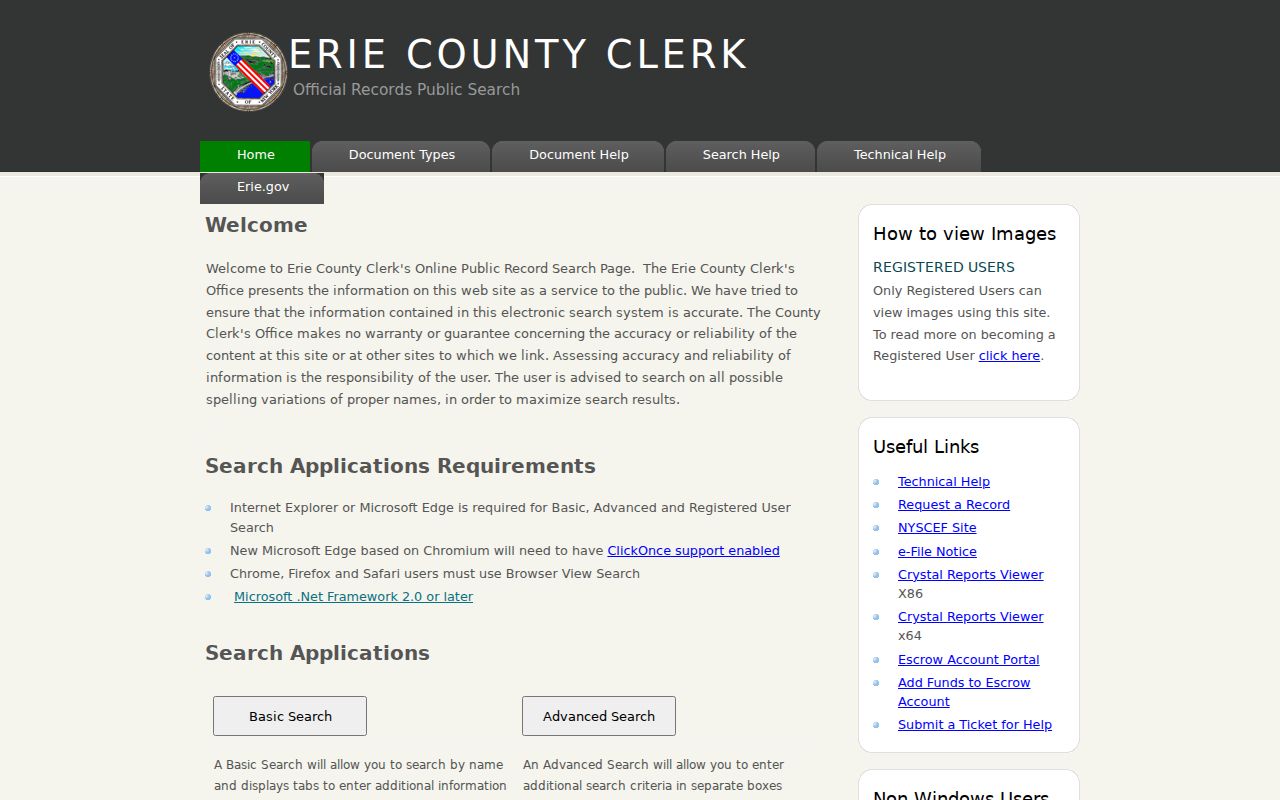
Use the parcel result to narrow the Clerk query instead of expecting a land-record address search to do that work.
Erie County Clerk Record Trails
The Erie County Clerk BrowserView supports basic and advanced searching by party name, document type, instrument number, book and page, map number, parcel ID, date, and legal-description fields. Party names are shown in last-name-first-name form without commas. Results can show an instrument number, type, recorded date, book and page, consideration, parcel ID, parties, and linked documents. A registered account is required for online images, while the public can search metadata. BrowserView is also the practical route for many non-Windows users.
Coverage must be read by series. Deeds are maintained from 1808, but the online index begins January 1, 1986 and deed images begin January 1, 1960. Older images can require Liber or Book and Page through the Graves Index, and older books may need an office visit or request. Mortgages have separate cutoffs. The County Clerk’s records-kept schedule is the best place to confirm a category before deciding a blank search means the record is absent.
A capture of the Clerk’s records-kept page is useful because it shows the county’s category-by-category coverage map.
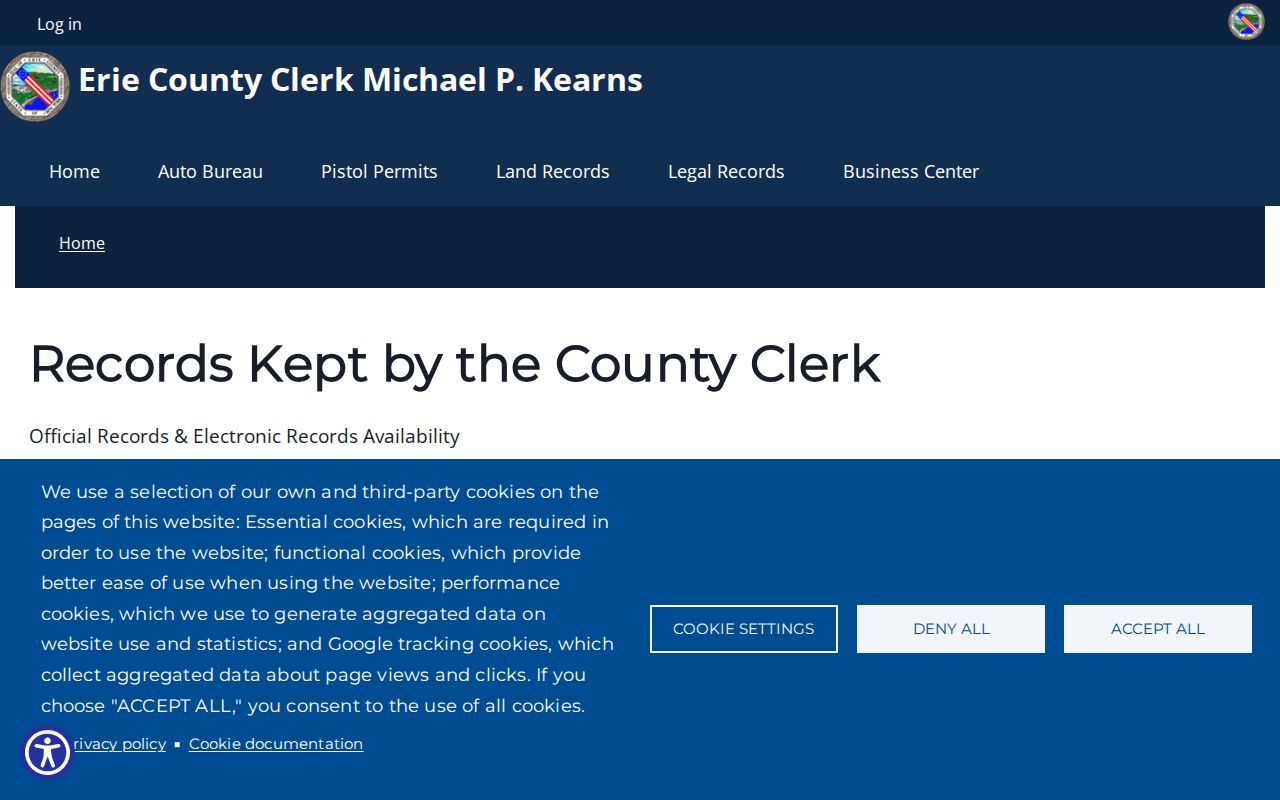
The key Erie County lesson is simple: an address becomes a parcel, then a legal description or party trail, before it becomes a deed-chain search.
Erie County Current Resident Directories
Current directory-like sources have specific coverage. A parcel roll identifies owners and mailing contacts. A court index identifies people in eligible public cases. The voter tool is self-service, not an address-browsing directory. License and business databases can confirm a public credential or filing but do not establish a home. These limits make a second source essential for a careful Erie County residents directory search.
| Erie County source | What it confirms | Custodian | Access |
|---|---|---|---|
| Parcel and tax roll | Owner, situs, mailing address, SBL | Real Property Tax Services | Public portal |
| Deed index | Recorded parties and title instruments | Erie County Clerk | Modern index, copies or requests |
| Voter self-lookup | Cooperative registration confirmation | New York elections | County, name, DOB, ZIP |
| Eligible court index | Public party appearance | NYS courts and Clerk | Portal or clerk route |
| License or DBA record | Public credential or business filing | NYS DOS or County Clerk | Record-specific search |
For one person, match two identifiers before drawing a conclusion. The Erie County resident lookup has the record-by-record verification sequence. A trust, estate, corporation, or mailing agent can appear in property data without being a household.
Erie County Voter Lookup Limits
New York’s voter registration lookup asks a voter to select county and provide last name, first name, date of birth, and ZIP. It is designed for a person checking their own registration and can provide registration or polling information for a successful match. It is not a street browser. A mismatch may come from a different ZIP, a name change, recent move, inactive status, or a confidential record.
Erie County’s full-file request form has its own route and limitations. It asks for a purpose, geographic scope, format, requested fields, party choices, and an elections-purpose certification. Election Law §3-103(5) restricts voter-list use. Voting history, when legitimately requested, records participation rather than ballot choices. Historical poll books are more likely to be found through the State Archives, Buffalo Records Management, or library microfilm.
A capture of the official voter lookup shows the county, name, date-of-birth, and ZIP inputs required for its limited confirmation function.
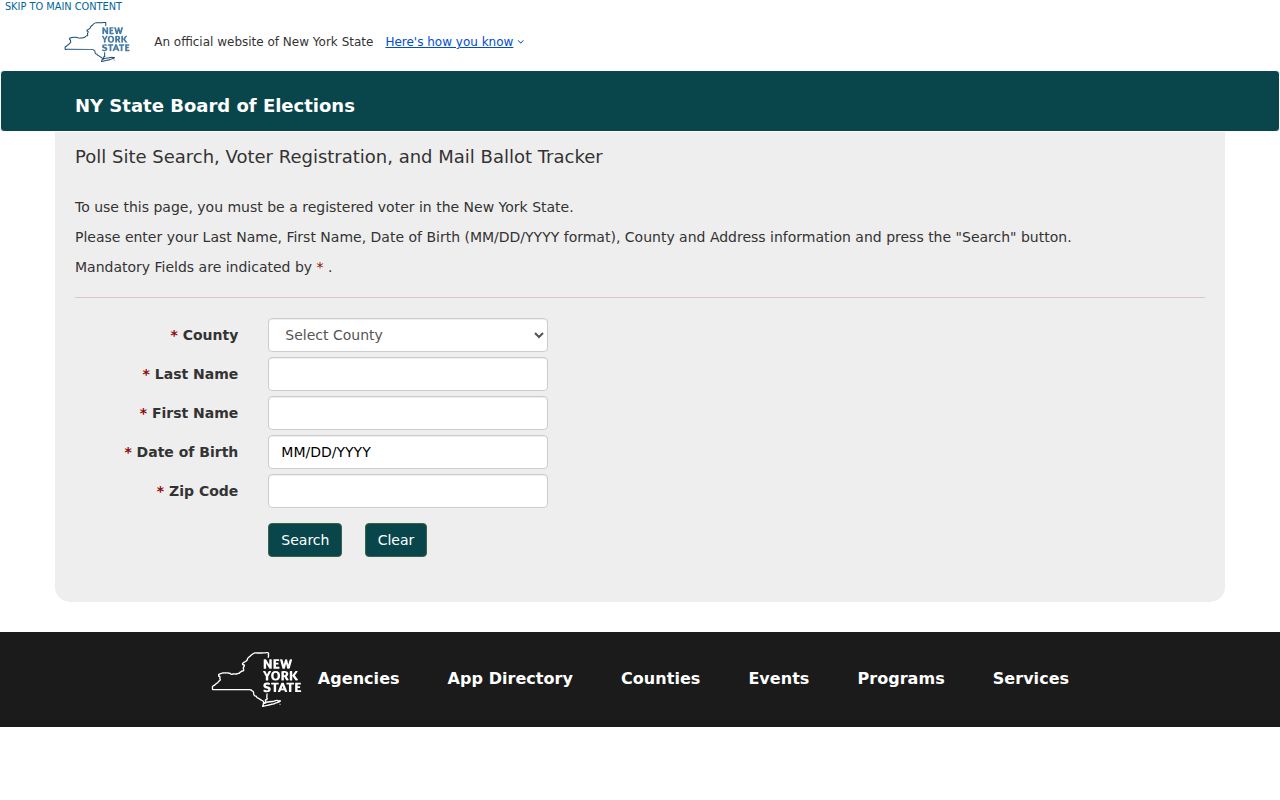
Use a returned voter result as one dated piece of evidence, not a complete resident roster.
Erie County Court Record Checks
For a public court matter, search the court most likely to hold it. NYSCEF supports eligible searches by case identifier, name, county, case type, date, and certain block-and-lot fields. Erie e-filing has its own dates and covered case types. WebCivil, E-Track, WebCriminal, local clerks, Surrogate’s Court, and federal PACER cover different material. Sealed, family, adoption, youthful-offender, and other protected matters are excluded from ordinary public results.
Vital records follow the event location and eligibility rule. Buffalo events before January 1, 1914 remain a City Clerk route. The New York State Department of Health offers genealogy copies under age-and-death rules: births are generally at least 75 years old with death known, deaths 50 years old, and marriages 50 years old with both spouses known deceased. Certified birth access follows Public Health Law §4173. A library index can supply a lead, while the registrar controls a certificate.
The official New York genealogy access page illustrates the distinct state route for older events.
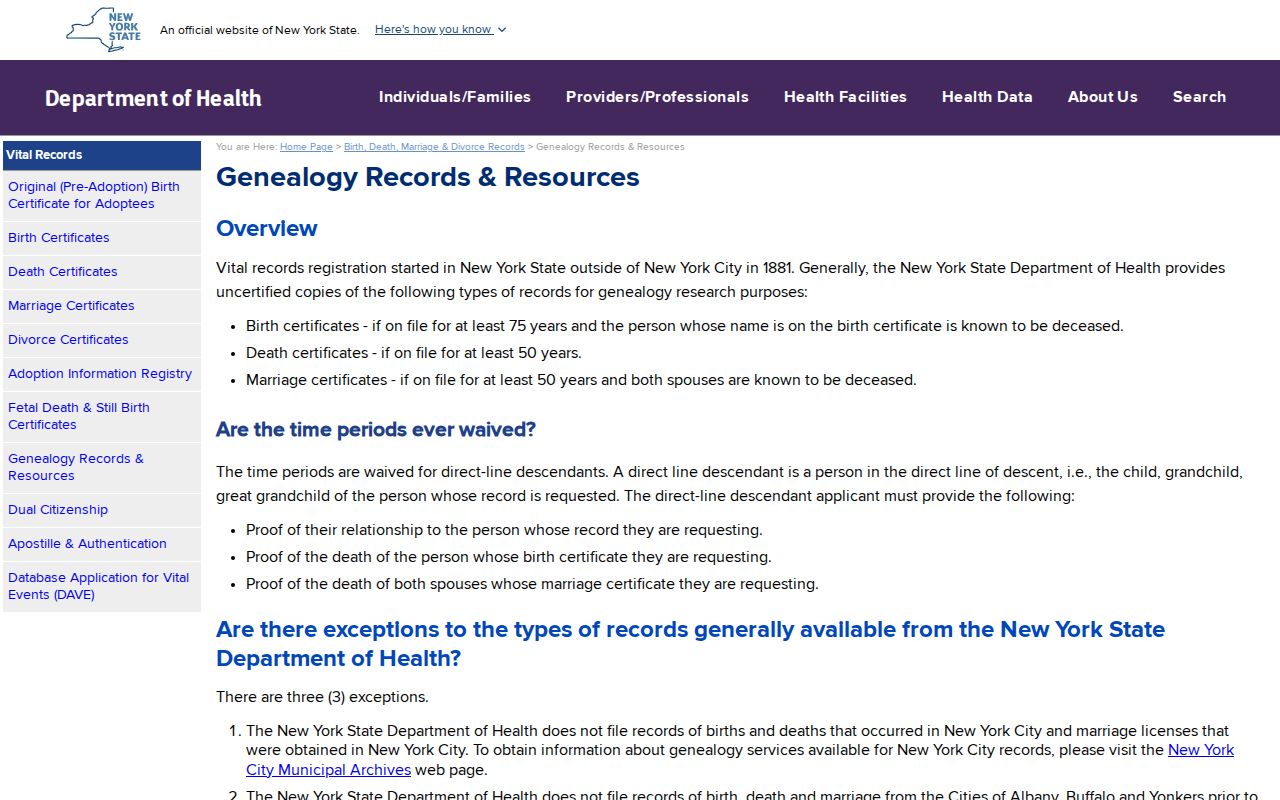
Keep a court party, a vital event, and a residence claim separate unless dates and independent records genuinely connect them.
Erie County Municipal Record Collections
Buffalo adds a substantial municipal layer to an Erie County residents directory search. The Buffalo City Clerk at 65 Niagara Square, Room 1308 keeps Buffalo birth, marriage, and death records, ordinances, Common Council records, dog licenses, and related certificates. Buffalo Records Management operates from the Inactive Storage Center at 45 Comet Street by appointment. Its published holdings include assessor land maps from 1855, 1870, and 1912; birth indexes from 1878 to 1915; death indexes from 1852 to 1944; marriage indexes from 1877 to 1935; Erie County census microfilm from 1850 to 1925; incomplete Polk directories; and tax and assessment books.
Use the Buffalo Records Management inventory when a city record predates a web portal or a directory year is missing. There is no access fee for its listed historical material, although a genealogy vital-record copy can have a fee. The City Clerk, library, and Records Management Center are different custodians. A request should state the Buffalo event or address, record type, approximate date, and the exact identifier already located.
Erie County Historical Directory Shelves
Buffalo’s historical volumes are the strongest part of an older Erie County residents directory. The Buffalo & Erie County Public Library’s Grosvenor Room describes complete Buffalo directory coverage from 1828 to the present, with known publication gaps. Its holdings include digitized Buffalo directories from 1832 to 1913 through New York Heritage, yearbooks, obituaries, census, and local vital indexes. Later reverse or criss-cross sections can begin from an address and point to a listed household, although a listing is historical evidence rather than proof of residence.
The Buffalo History Museum holds Buffalo directories from 1828 through 2001 and suburban directories from 1949 through 2001. Buffalo Records Management adds incomplete Polk runs, census microfilm, tax books, and land maps. The historical approach is to compare an address section with the alphabetical entry, abbreviation key, census, and a deed or obituary. The fuller collection detail belongs in the Erie County city directory.
- Roll
- A dated list created for one administrative purpose, such as assessment or registration.
- Index
- A finding aid that identifies a record but may not include the image or full file.
- Criss-cross directory
- An address-organized directory that can point from a street number to a historical listing.
- Parcel
- A defined piece of land identified by an SBL, PIN, or legal description.
Erie County Record Digital Cutoffs
Erie County’s record history is not one smooth online timeline. The Clerk maintains deeds from 1808, while its online deed index and image access start decades later. Buffalo city directories have long runs, but the edition sequence has gaps. Buffalo permit data begins in 2007 and the code-violation dataset in 2016. Eligible Erie e-filed material has its own NYSCEF cutoffs. A search log should record the portal, date searched, spelling, coverage start, and result identifier so that another researcher can reproduce the route or request the older paper record.
Former Buffalo street names are another important continuity check. The city guide pairs current and former names such as Amherst and Ferry, or Porter and Guide Board Road. The guide does not supply effective years, so a year-specific conclusion needs a historic map, city record, or deed legal description. This is especially useful when an old directory entry appears to vanish from a modern map.
Note: Erie County’s free historical GIS data reaches back to 1999, but that archive does not replace the Clerk’s older deed books or the city’s microfilm.
Erie County Privacy Boundaries
Public records are not a reason to assemble a private household roster. Renters, boarders, utility customers, delivery recipients, and many household members do not appear in the property record. New York’s Address Confidentiality Program, Executive Law §108, can provide a substitute mailing address for qualifying participants. Election Law §5-508 protects qualifying voter registrations. Court sealing, vital-record rules, and the federal Driver’s Privacy Protection Act can also limit access.
Lawful personal use. Erie County records can support family history, estate work, personal safety, and civic research. Do not use an address, name, or record trail to stalk, harass, intimidate, or harm anyone.
When a name does not appear, do not announce that a person is protected or absent. The responsible office can explain a record’s access rule without exposing protected data. A correction request also belongs with the custodian that created the record, not with a search result copied elsewhere.
Erie County Official Sources Compared
Official records are often slower than a compiled people-search category, but they identify the keeper, date, field, and access limit. That makes an error easier to challenge. A commercial category can combine old addresses and name variants, yet it may merge people with the same name or retain stale information. For a meaningful Erie County residents directory result, the custodian’s parcel card, court docket, Clerk instrument, library volume, or state lookup should be the verification layer.
| Source type | Strength | Limit |
|---|---|---|
| Official custodian record | Dated source and correction path | Often series-specific or restricted |
| Library or archive collection | Historical context and older coverage | Listing may not prove current status |
| Compiled commercial category | Can supply a lead | May be stale or combine same-name people |
Ask the Clerk, court, library, or registrar for the smallest record that answers the question. A narrow request with a name, municipality, approximate date, and known identifier is more useful than a request for every item connected to a person.
Tracing Erie County Record Gaps
When the online trail ends, keep the last solid identifier and choose the next custodian. A pre-1986 deed index search may need book and page work. A Buffalo historical household may need the Grosvenor Room, the History Museum, or Records Management. A death or marriage event may need the local registrar rather than the county office. New York Freedom of Information Law, Public Officers Law Article 6, §§84-90, is a route for existing agency records, but it does not override sealing, vital-record restrictions, or protected voter status.
Erie County’s value as a research place lies in these cross-references: parcel to SBL, SBL to deed, directory to census, and event index to issuing office. Label each fact by source and date, then stop when the available records do not support a confident match.